


Stretch film is an essential packaging material for securing palletized goods during storage and transportation. لكن, when wrapping settings are poorly adjusted or packaging methods are inconsistent, businesses can end up using more film than necessary. Over time, this increases material costs, creates unnecessary packaging waste, and reduces the overall efficiency of warehouse operations.
For manufacturers, logistics providers, and distribution centers handling large volumes of pallets, improving pallet stretch wrapping efficiency can make a noticeable difference. The goal is not simply to use less film, but to achieve reliable load stability with the right amount of material.
So, how can businesses reduce stretch film waste without compromising packaging quality? The answer involves several factors, from film selection and wrapping settings to choosing suitable automatic packaging equipment.
1. Choose the Right Stretch Film for Your Loads
One of the first steps in reducing stretch film waste is selecting a film that matches the characteristics of the products being wrapped. Different pallet loads require different levels of film strength, elasticity, and puncture resistance. Heavy materials with sharp edges may need a more durable film, while lightweight cartons or regularly shaped products may be secured with a thinner film, provided it offers sufficient holding force.
Using film that is unnecessarily thick can increase packaging costs. On the other hand, choosing film that is too thin may lead to tearing, unstable loads, and repeated wrapping.
Businesses should evaluate:
- Load weight and overall dimensions
- Product shape and edge conditions
- Film thickness and puncture resistance
- Stretchability and holding force
- Storage and transportation requirements
The right film specification helps achieve consistent load protection without consuming more material than the application requires.
2. Optimize Wrapping Tension and Film Application
Incorrect wrapping tension is another common reason for excessive film consumption. If the tension is too low, the film may not hold the pallet load securely, requiring additional wrapping cycles. If it is too high, the film may stretch excessively, tear, or damage products with less rigid packaging.
A properly configured stretch film wrapping machine allows operators to adjust wrapping parameters according to the load being handled. These may include film tension, wrapping speed, overlap, and the number of wrapping layers. Rather than applying the same settings to every pallet, businesses should establish suitable wrapping programs for different product types. على سبيل المثال, a pallet of lightweight cartons may require a different wrapping pattern from a load of heavy building materials. Matching the wrapping settings to the actual load helps reduce unnecessary film use while maintaining package stability.
3. Avoid Excessive Wrapping Layers
Adding more layers of stretch film does not always mean better load protection.
In some operations, pallets are wrapped with excessive film because operators are unsure how much material is actually needed. This often happens when wrapping procedures are inconsistent or equipment settings are not standardized.
A more effective approach is to test different wrapping patterns and evaluate the results under realistic handling conditions.
Businesses should pay attention to:
- The number of top and bottom wraps
- Film overlap between layers
- Reinforcement around the pallet base
- Load stability after wrapping
- Film consumption per pallet
The objective is to identify the minimum practical wrapping pattern that keeps the load secure throughout handling and transportation. Standardized wrapping programs also make it easier to monitor stretch film usage per pallet and identify opportunities for improvement.

4. Use Automatic Pallet Wrapping Equipment for Consistent Results
Manual pallet wrapping can produce inconsistent results, particularly in warehouses where operators handle different products throughout the day. Film tension, wrapping speed, and the number of layers may vary depending on the operator.
An automatic pallet wrapping machine helps standardize these operations by controlling the wrapping process according to preset parameters.
Depending on the machine configuration, automatic functions may include film clamping, cutting, and wrapping cycle control. These features reduce repetitive manual handling and help maintain more consistent packaging results.
For businesses with high daily pallet volumes, an industrial stretch wrapper can also improve workflow efficiency and make film consumption easier to monitor.
The key advantage is process consistency. When wrapping conditions are controlled, businesses have a better opportunity to identify excessive film usage and optimize their packaging procedures.
5. Consider a Rotary Arm Stretch Wrapper for Unstable Loads
The type of pallet wrapping machine also matters, especially when handling loads that are difficult to rotate.
A conventional turntable stretch wrapper rotates the pallet during the wrapping process. While this arrangement works well for many standard loads, rotation may create challenges when products are lightweight, unstable, oversized, or stacked at a considerable height.
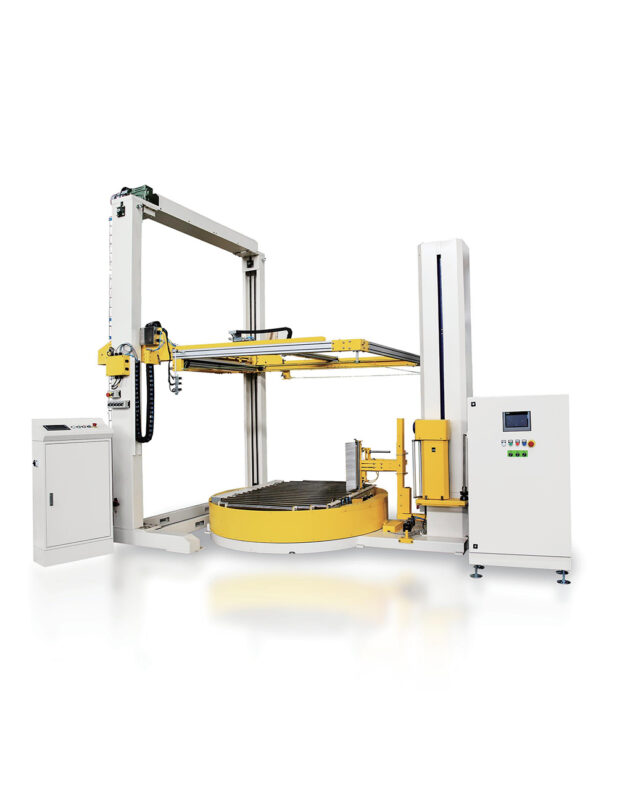
A rotary arm stretch wrapper uses a different operating principle. Instead of rotating the pallet, the wrapping arm moves around the stationary load to apply stretch film.
Keeping the load stationary can be particularly useful for fragile products, tall stacks, and pallets that may shift during rotation.
For warehouses handling mixed pallet loads, this machine configuration provides another way to improve wrapping consistency. When combined with suitable film selection and properly adjusted wrapping parameters, it can help businesses achieve secure packaging without relying on unnecessary additional layers.
For applications involving heavy or unstable loads, choosing the right pallet stretch wrapper should therefore be part of the overall packaging optimization process.
6. Monitor Film Consumption and Maintain Equipment
Reducing film waste is not a one-time adjustment. It requires regular monitoring of packaging performance.
A practical starting point is to record the amount of stretch film used for each pallet or product category. Comparing film consumption across different wrapping programs can help identify where material is being wasted.
Equipment maintenance is equally important. Worn rollers, incorrect film alignment, or inconsistent tension control can affect the wrapping process and lead to uneven film application.
Regular inspections should cover:
- Film carriage and roller condition
- Film feeding and clamping mechanisms
- Cutting system performance
- Wrapping tension consistency
- Program settings and operating conditions
Keeping the machine properly maintained helps ensure that wrapping performance remains consistent over time.
Choosing the Right Pallet Stretch Wrapper for Your Business
Reducing stretch film waste involves more than purchasing thinner film or reducing the number of wrapping layers. Businesses need to consider the entire packaging process, including load characteristics, film specifications, wrapping parameters, and equipment performance.
For operations handling heavy, unstable, lightweight, or oversized pallet loads, a rotary arm pallet stretch wrapper can be a practical solution because the load remains stationary while the wrapping arm rotates around it.
Mystech Woods provides pallet wrapping equipment designed for industrial packaging applications. When evaluating a suitable machine, businesses should consider pallet dimensions, maximum load weight, product stability, and required packaging capacity.
The right equipment configuration can help create a more consistent wrapping process, improve load stabilization, and support more efficient use of packaging materials. Looking for a suitable pallet stretch wrapping solution? Contact Mystech Woods to discuss your product characteristics, pallet dimensions, and packaging requirements.