


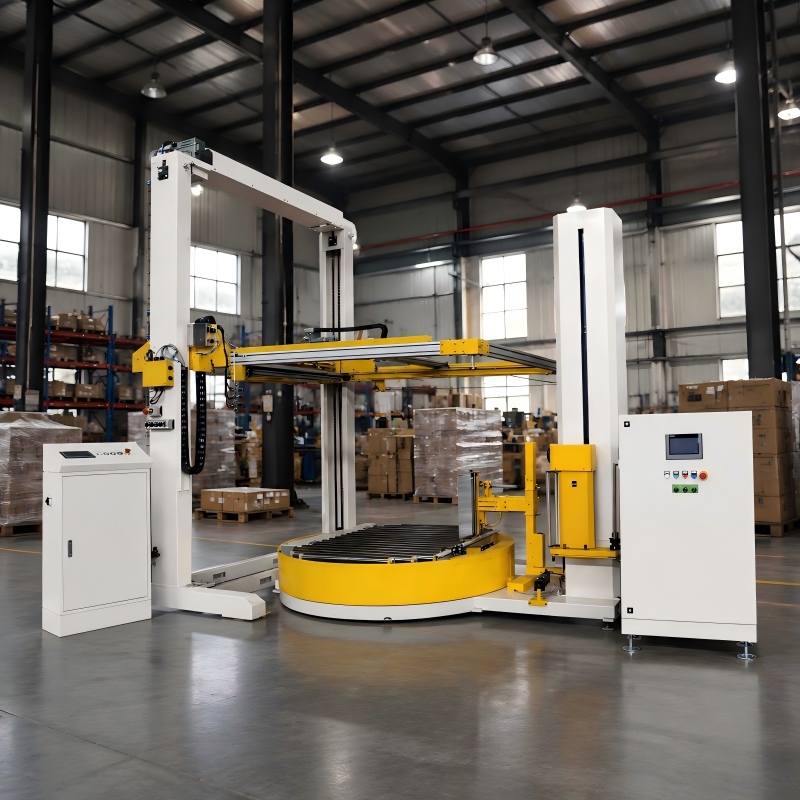
In modern industrial logistics systems, pallet unitization has become a foundational requirement for safe, stable, and cost-efficient cargo handling. Within this system, the pallet stretch wrapper is no longer a supplementary packaging device—it is a load containment engineering solution designed to control dynamic instability during storage and transportation.
From an engineering perspective, the function of a pallet wrapping machine is not simply film application. It is a controlled tension system that stabilizes heterogeneous loads under acceleration, vibration, stacking pressure, and long-distance logistics conditions. As a professional pallet wrapper manufacturer, Mystech Woods develops industrial-grade pallet wrapping equipment designed for high-throughput environments and unstable load geometries. One of its advanced systems, the MH-FG-2000D + MH-FG-2000RC Rotary Arm Pallet Stretch Wrapper, is specifically engineered for heavy, oversized, or structurally unstable pallet configurations.
1. Engineering Role of Pallet Stretch Wrapping Systems
A stretch film wrapper machine functions as a load stabilization subsystem within a warehouse or production line. Its engineering objective is to achieve:
Core technical functions
- Load unitization via circumferential film tension
- Horizontal shear resistance during transport vibration
- Vertical compression stabilization for stacked goods
- Friction coefficient control between layers
- Film pre-stretch optimization for material efficiency
Unlike manual wrapping, automated systems maintain repeatable tension profiles, which is critical for logistics standardization across multi-site supply chains.
2. System Architecture: MH-FG-2000D + MH-FG-2000RC
The MH-FG-2000D + MH-FG-2000RC is a rotary arm pallet wrapping system, designed for scenarios where load rotation is structurally unsafe.
⚙️ Mechanical Principle
Instead of rotating the load (as in a turntable system), the rotary arm rotates around a stationary pallet.
Engineering implications:
- Eliminates inertial force on unstable cargo
- Prevents toppling risk for high-center-of-gravity loads
- Supports non-uniform pallet geometry
- Enables integration into in-line conveyor systems
🧩 Integrated Functional Modules
| Module | Function | Engineering Outcome |
|---|---|---|
| Rotary arm drive system | Orbital film application | Stable wrapping without load movement |
| Automatic film clamping unit | Pre-fix film tail | Eliminates manual intervention |
| Film cutting system | Automatic separation | Increases cycle consistency |
| Pre-stretch mechanism | Film elongation control | Reduces material cost per pallet |
| PLC control system | Parameter programming | Standardized wrapping cycles |
This configuration positions the system as a high-stability pallet wrapping equipment platform, suitable for continuous industrial operation.
3. Industry Segmentation Based on Load Behavior
The applicability of a pallet stretch wrapper depends less on industry label and more on load behavior characteristics:
- Structural stability (stable / unstable)
- Weight distribution (uniform / asymmetric)
- Stack height (low / high / ultra-high)
- Product fragility (rigid / deformable)
- Handling frequency (single / multi-stage transport)
Based on these engineering parameters, industries can be segmented as follows:
3.1 High-Throughput Logistics & Distribution Centers
Load characteristics:
- Mixed SKU pallets
- Frequent handling cycles
- High acceleration transport environments
Engineering requirement:
- Consistent load containment force
- High cycle speed (throughput priority)
- Integration with conveyor automation
Why pallet stretch wrapper is critical:
Without standardized wrapping force, pallet deformation increases significantly during forklift acceleration and truck vibration phases.
The pallet wrapping machine ensures:
- Predictable containment force curve
- Reduced product redistribution inside pallet
- Improved warehouse-to-warehouse transfer stability
3.2 Food, Beverage & Cold Chain Logistics
Load characteristics:
- High repetition pallet structures
- Moisture-sensitive packaging
- Temperature fluctuation exposure
Engineering requirement:
- Hygienic, non-contact stabilization
- Moisture barrier reinforcement
- Consistent low-film tension wrapping
The stretch film wrapper machine provides:
- Controlled film layering for condensation resistance
- Structural stabilization during refrigeration cycles
- Reduced contamination exposure points
In cold-chain systems, wrapping failure directly correlates with product loss ratio, making automation essential.

3.3 Building Materials & Heavy Industrial Goods
Load characteristics:
- High mass density
- Irregular stacking geometry
- Edge instability (brick, tile, cement bags)
Engineering requirement:
- High pre-stretch force
- Maximum load containment tension
- Structural reinforcement against lateral collapse
A rotary arm pallet wrapping equipment system is preferred because:
- Load does not experience rotational inertia
- Heavy stacks remain mechanically static
- Film tension can be increased without collapse risk
3.4 Paper, Packaging & Compressible Materials
Load characteristics:
- Low rigidity
- Compression-sensitive edges
- High deformation risk
Engineering requirement:
- Controlled film tension distribution
- Low-impact wrapping force
- Surface protection against edge crushing
The system ensures:
- Uniform pressure distribution
- Prevention of layer shifting
- Moisture barrier integrity during storage
3.5 E-commerce Fulfillment & Multi-SKU Warehouses
Load characteristics:
- Highly variable pallet configurations
- Frequent changeovers
- Peak load fluctuations
Engineering requirement:
- Programmable wrapping profiles
- Rapid cycle adaptability
- Integration with WMS/automation lines
The pallet wrapping machine becomes a scalability enabler, not just a packaging tool:
- Supports batch variability
- Reduces operator dependency
- Stabilizes mixed-load shipments

4. Turntable vs Rotary Arm: Engineering Decision Matrix
| Parameter | Turntable System | Rotary Arm System (MH-FG-2000D/RC) |
|---|---|---|
| Load movement | Required rotation | Fully stationary |
| Stability risk | Medium to high | Very low |
| Heavy load suitability | Limited | High |
| Fragile load handling | Risk of shift | Safe |
| Automation integration | Moderate | High |
Conclusion: Rotary arm systems are structurally superior for unstable, heavy, or high-value palletized loads.
5. Manufacturer-Level Considerations in Equipment Selection
Selecting a pallet wrapper manufacturer is fundamentally a systems engineering decision, not a procurement decision.
Critical evaluation parameters include:
- Film pre-stretch consistency (material efficiency factor)
- Mechanical torque stability of rotary arm
- PLC control precision and cycle repeatability
- Integration capability with conveyor systems
- Long-term maintenance architecture
Mystech Woods designs its systems to meet industrial uptime requirements rather than standalone machine performance, ensuring continuous operation in 24/7 logistics environments.
Conclusion:
Industries that benefit most from pallet stretch wrappers, pallet wrapping machines, and advanced pallet wrapping equipment are not defined by sector alone, but by operational load instability, throughput demand, and logistics complexity. The MH-FG-2000D + MH-FG-2000RC Rotary Arm Pallet Stretch Wrapper represents a high-stability engineering solution designed for environments where traditional wrapping systems fail under structural load constraints.
In modern supply chain architecture, pallet wrapping is no longer a packaging step—it is a load containment engineering system, and selecting the right system directly impacts damage rate, logistics efficiency, and total operational cost.