


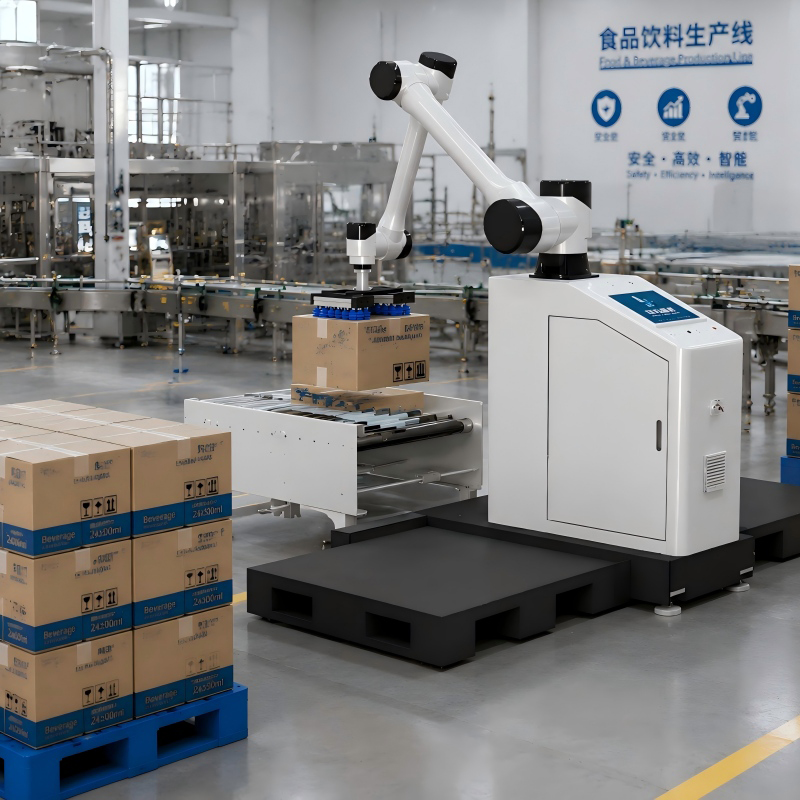
Walk into any modern food or beverage factory, and you’ll notice one thing very clearly: production lines are getting faster, but people on the end-of-line packaging area are getting fewer.
The reason is simple—palletizing has become one of the most exhausting and inconsistent parts of the whole process. This is exactly why more factories are starting to adopt the collaborative robot palletizer instead of relying purely on manual labor or traditional automation systems.
1. The real problem factories are trying to solve
In food and beverage production, palletizing usually happens at the very end of the line—but it often becomes the bottleneck.
Operators have to:
- Lift cartons repeatedly for hours
- Adjust stacking patterns for different SKUs
- Handle wet, slippery, or soft packaging
- Keep up with fast production speeds
Over time, this leads to:
- Labor fatigue
- Unstable stacking quality
- Higher injury risk
- Production interruptions during peak demand
This is where factories start comparing options like industrial robot palletizer systems versus more flexible cobot solutions.
2. Why cobots fit food & beverage environments better
Unlike traditional heavy automation systems, a cobot palletizer is designed to work in tighter spaces and more flexible production setups.
For many factories, this is the key difference.A system like the Mystech Woods MD—630 collaborative robot palletizer is especially popular because it doesn’t require complex programming. Operators can simply set pallet patterns through a touchscreen interface, which is much closer to “production floor usability” than engineering-level coding.
This matters a lot in real factories, because:
- Line changes happen frequently
- Workers are not robotics engineers
- Downtime must be minimized
The MD—630 makes palletizing feel less like “automation integration” and more like “plug-and-run equipment.”

3. What makes food & beverage factories adopt cobot palletizing
There are three practical reasons most factories make the switch:
🟦 1. Stability in high-speed production
Food and beverage lines don’t stop easily. A collaborative robot palletizer keeps stacking consistent even when human operators would slow down or get tired.
🟦 2. Hygiene and handling safety
Less manual contact means fewer risks in environments like bottled drinks, dairy, or packaged food production.
🟦 3. Fast SKU switching
Factories often switch between carton sizes, bottle packs, or mixed pallets. A flexible robot palletizing system is much easier to adjust compared to fixed traditional systems.
4. Collaborative robot palletizer vs industrial robot palletizer
This is usually where decision makers hesitate.
| Factor | Collaborative Robot Palletizer | Industrial Robot Palletizer |
|---|---|---|
| Setup complexity | Low | High |
| Safety fencing | Not always required | Required |
| Space requirement | Compact | Large |
| Flexibility | High | Medium |
| Best for | Medium & flexible production | Large-scale fixed lines |
In food and beverage factories, production is rarely “one fixed pattern forever,” which is why many plants prefer cobots over a full industrial robot palletizer system.
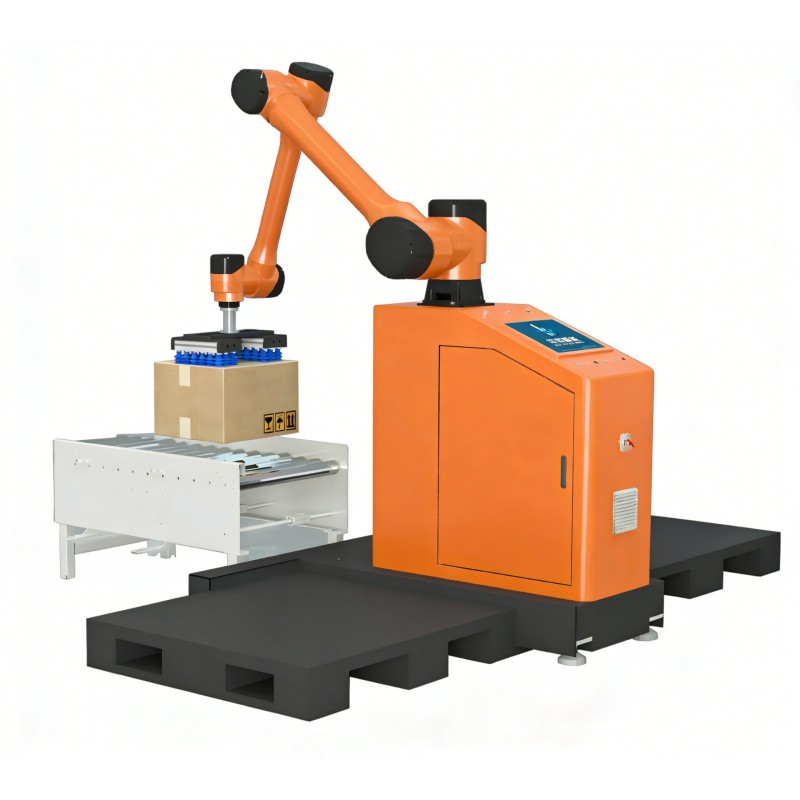
5. What the MD—630 actually brings to production lines
The Mystech Woods MD—630 collaborative robot palletizer is not just about automation—it is designed to remove friction from daily operations.
Key practical advantages include:
- Visual touchscreen operation (no coding required)
- Quick pallet pattern setup
- Compact footprint for limited factory space
- High payload capability for cartons and beverage cases
- Ability to run standalone or integrate into conveyor lines
It can also connect with:
- Automatic pallet dispensers
- Conveyor systems
- Full end-of-line automation setups
This makes it a scalable step—factories can start small and expand later.
6. Why suppliers matter more than machines
In real projects, the machine is only half the story.
Choosing the right cobot palletizer supplier or robot palletizing system manufacturer often determines whether the system actually works smoothly in production.
Factories usually care about:
- Installation speed
- On-site debugging support
- Compatibility with existing lines
- Long-term maintenance reliability
This is why manufacturers like Mystech Woods position themselves not just as equipment providers, but as system integration partners.
7. Where cobot palletizers are used most in food & beverage
Typical applications include:
- Bottled water production lines
- Beverage filling and packing lines
- Snack food packaging
- Dairy and chilled product logistics
- Carton-based FMCG distribution centers
In all these cases, the requirement is the same: stable stacking with minimal downtime.
Conclusion:
Food and beverage factories don’t adopt a collaborative robot palletizer just because it is “modern automation.”They adopt it because it solves very practical problems:
labor shortage, inconsistent pallet quality, frequent SKU changes, and production pressure.
Compared with traditional industrial robot palletizer systems, cobots offer a more realistic balance between automation, flexibility, and usability. For many factories, systems like the Mystech Woods MD—630 collaborative robot palletizer are not just equipment upgrades—they are operational upgrades that directly improve how the production line actually runs every day.